Redesign of Superhuman Workflows Now That AI Is Here 0/<
current workflows were designed with the assumption that cognitive agents proficient in natural language cognition does not exist.
But now that they are here, the workflows WILL change. how do we want our newer systems to be?
this is how any engineering division in company looks like. CXOs decide where does company want to move. low level executive decides what do we need to do to achieve that goal. That passes down to engineering directors (managers of managers). engineering directors go on meetings with all managers (experts of their own areas for example data-science, frontend, backend, devOps etc). Till here most work happens in documents, sheets or niche personalised softwares.
Individual team managers’ work involves lots of meetings (Zoom, Google Meet, Microsoft Teams, Slack), documents (Google Docs), excel sheets to track (Google Sheets).
Staff and principal engineers work at the same level but more on the technical side. Even their daily life goes around the same tools.
Under them are L1, L2 and L3 engineers who work with a long list of software tools: slack, github, IDEs, jenkins, argoCD, grafana, looker, jira, confluence, terraform, snowflake, databricks…
| role | tasks & tools |
|---|---|
| L1, L2, L3 engineers | ”it works on my machine.” IDEs, personal scripts, personal notes, personal todos, docker desktop, local kube clusters, GitHub, Slack, Google Docs, Chrome. |
| staff / principal engineers | brainstorming, whiteboarding, architecture, testing if systems blow up. miro, excalidraw, confluence docs, zoom/meet calls, slack threads, jira epics, excel, google docs. |
| team managers | 1:1s with everyone, zoom/calendar, HR feedback platforms, jira tracking, calls with PMs, sales, customer support, getting those people to talk to their team. |
| product managers | PRDs, product analytics softwares, calls with engineers, managers and staff. sits in the tension between shipping pressure and engineering constraints. |
| deploy / infra | jenkins, github actions, argoCD, terraform, grafana, cloud management. |
| alerts / ops | pagers, datadog, on-call duties. |
| engineering directors | managers of managers. think about headcounts, how much are we spending on what, and talk to executives. |
| product designers | UI/UX. figma. |
| security | i don’t know much about them. |
| testers | x0 || x| |
most tools junior devs use can now be connected to LLMs. So most things junior engineers do can be done by agents. (not just a guess anymore — it’s real.)
Every junior engineer’s productivity will increase many many x going forward. We will either have very few junior engineers working in companies, or one junior engineer might be producing 5 engineers’ output. THIS WILL DIRECTLY AFFECT EVERYONE WORKING ABOVE THEM.
For everyone above junior engineers two things will happen. first, they will also have an agent as an assistant. second, they will have a lot less people to manage and a lot more work to review.
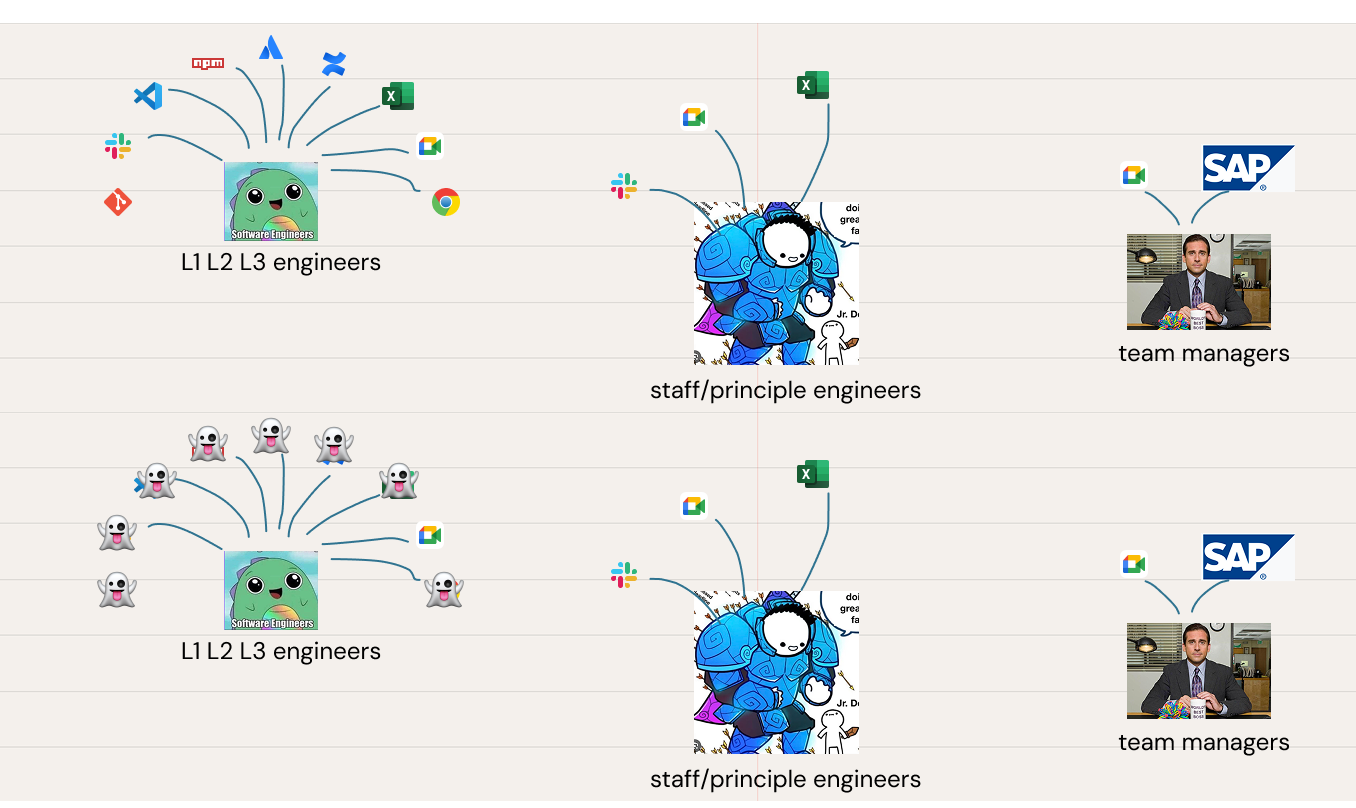
junior engineers will now, instead of working with tools themselves, monitor agents working on them. they might monitor 5 to 6 agents at a time and fill in wherever the agent requires human judgement. They will be instructing and observing more instead of doing.
newer multi-agent tools will come in workflows.
So tools that let us instruct (message apps, audio message apps) and observe (dashboards, analytics, alerts apps) will see themselves getting integrated more.
tablet devices and microphone devices which are perfect for instruction and observation will be in demand. (not just hardware — even instruct-and-observe softwares will be produced more.)